Which Basketball Is Best for Indoor and Outdoor Courts?
Finding the perfect basketball that performs flawlessly on both pristine hardwood indoor courts and rugged asphalt outdoor blacktops is the ultimate quest for hoopers. The short answer is: the best basketball for indoor and outdoor courts is a high-quality composite leather hybrid basketball. While pure leather is strictly for indoors and cheap rubber is built for the streets, a premium composite hybrid offers the optimal balance of grip, durability, bounce consistency, and hand-feel. Models like the Wilson Forge Series or the Spalding TF-250 excel in these dual-environment scenarios, providing a reliable grip without disintegrating after a few games on concrete.
Whether you are running full-court pickup games at the local park or practicing your free throws in a climate-controlled gymnasium, playing with the wrong ball can ruin your shooting mechanics and drain your wallet. In this comprehensive guide, we will break down the science of basketball construction, compare the top-performing multi-surface basketballs on the market, and help you select the exact ball that matches your playing style, budget, and court preferences.
The Core Dilemma: Hardwood vs. Blacktop Environments
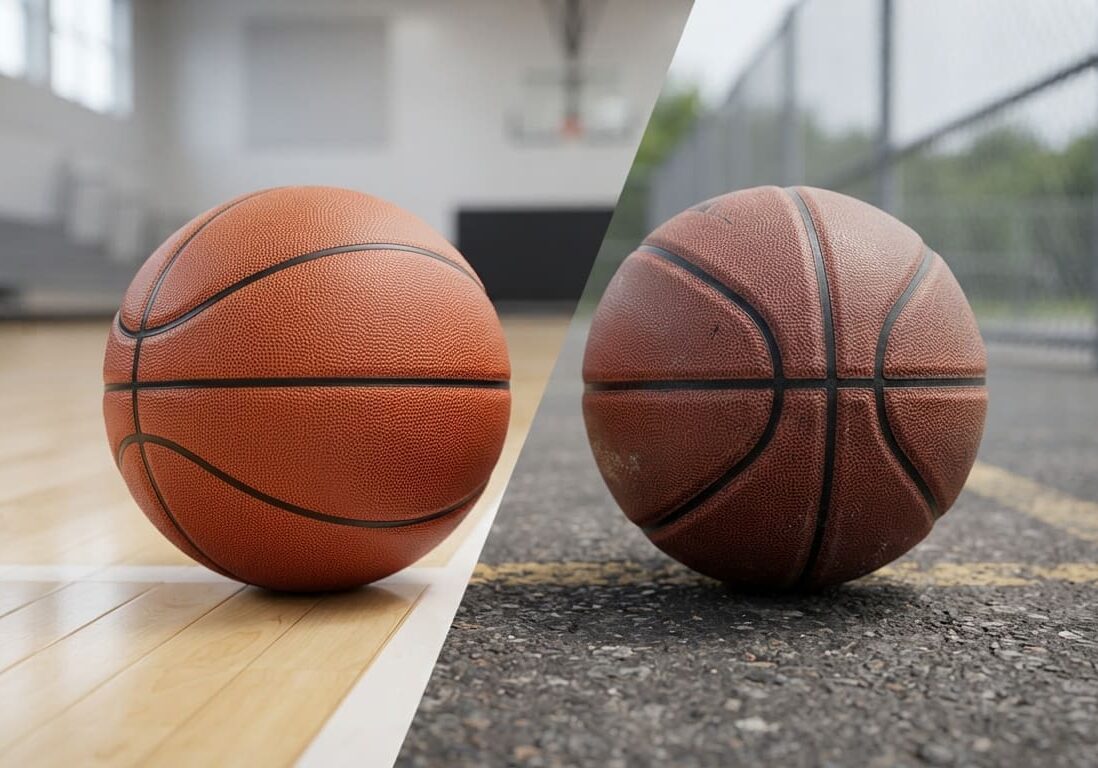
To understand why most basketballs are specialized for one surface, we must examine how indoor and outdoor courts interact with the ball’s outer casing. Indoor courts, typically made of polished maple hardwood, are clean, consistent, and forgiving. Outdoor courts, made of concrete, asphalt, or gritty outdoor tile, are abrasive, dirty, and exposed to unpredictable weather conditions.
When playing indoors, the primary enemies of a basketball are dust and sweat. The ball needs a moisture-wicking cover that maintains its tackiness even when hands get sweaty. On the other hand, outdoor play introduces abrasive friction, dirt, moisture, and UV rays. A premium indoor leather ball will quickly scuff, lose its grip, absorb dirt, and become permanently ruined if played on concrete for even a single afternoon. Conversely, a cheap outdoor rubber ball will feel slick, stiff, and unpredictable on a hardwood court.
According to the basketball training and court experts at Big Time Hoops, choosing the right ball is not just about saving money; it is about protecting your shooting muscle memory. A ball that bounces too high or slips out of your hands due to poor surface compatibility can actively damage your ball-handling and shooting mechanics.
Anatomy of a Basketball: Materials Demystified
To make an informed purchase, you must understand the three primary materials used in basketball manufacturing. Each material serves a specific purpose and dictates where the ball should be used.
1. Genuine Leather (Indoor Only)
Genuine leather basketballs, such as the official NBA game ball (Wilson Official Game Ball), are the gold standard for professional play. They are made from 100% full-grain horween leather. These balls require a “break-in” period, during which the stiff leather softens up, darkens, and develops an unmatched, personalized grip. Never use a genuine leather basketball outdoors. The concrete will shred the expensive leather fibers instantly, and moisture will cause the ball to warp and lose its shape.
2. Composite Leather (Indoor/Outdoor Hybrid)
Composite leather is a synthetic material designed to mimic the feel of genuine leather while offering enhanced durability and moisture resistance. This is where the “hybrid” category lives. Manufacturers can engineer composite leather to be soft and moisture-absorbing (optimized for indoors) or tough and wear-resistant (optimized for both indoor and outdoor play). High-end hybrid composite balls offer the best of both worlds: a soft, leather-like feel with the structural integrity to withstand asphalt.
3. Rubber (Outdoor Only)
Rubber basketballs are highly durable, inexpensive, and completely waterproof. They are constructed from vulcanized rubber, making them highly resistant to punctures, gravel, and rough outdoor play. However, rubber balls have a very bouncy, “pingy” feel, offer minimal moisture absorption, and can become incredibly slick when dusty. They are ideal for recreational outdoor play, driveways, and playgrounds, but are not recommended for serious indoor training.
Comparative Analysis: Basketball Materials at a Glance
The table below compares the three primary basketball materials across key performance metrics to help you visualize their strengths and weaknesses:
| Material Type | Primary Court Surface | Durability (Outdoors) | Grip & Feel | Price Range | Break-In Required? |
|---|---|---|---|---|---|
| Genuine Leather | Indoor Only | Extremely Low (Do not use) | Elite (Post-break-in) | $100 – $200+ | Yes (Several weeks) |
| Premium Composite | Indoor / Outdoor Hybrid | Moderate to High | Excellent to Very Good | $40 – $80 | No (Ready to play) |
| Vulcanized Rubber | Outdoor Only | Extremely High | Moderate (Slick when dusty) | $15 – $30 | No (Ready to play) |
Top 4 Basketballs for Dual Indoor and Outdoor Use
If you want a single basketball that you can throw in your gym bag for indoor league nights and also use for weekend pickup games at the local park, these are the top-rated hybrid models available today.
1. Wilson Forge Pro / Forge Series
The Wilson Forge Pro is widely regarded as one of the best multi-surface basketballs on the market. It features Wilson’s Pure Feel Cover, which is engineered for pro-level feel and long-lasting durability. The Real Grip Coating enhances control, while the inflation retention lining ensures consistent air pressure over extended outdoor sessions. It mimics the feel of the famous Wilson Evolution but is built with a tougher composite blend that won’t peel on asphalt.
2. Spalding TF-250 All-Surface
Spalding’s TF series has a rich heritage in basketball. The TF-250 is designed specifically as a transitional ball. It features a utility composite leather cover that provides a much softer feel than a standard rubber ball, yet it retains excellent structural durability against rough concrete. It is an excellent budget-friendly option for players who split their time 50/50 between indoor and outdoor courts.
3. Molten BG3800 Series
Molten is the official ball manufacturer for FIBA international play. The BG3800 is a 12-panel composite leather ball approved for both indoor and outdoor use. Its unique 12-panel design provides more seams, which translates to better fingertip control and alignment for shooting. The composite cover is highly scuff-resistant, making it a favorite for international players who transition frequently between indoor clubs and outdoor courts.
4. Nike Dominate / Nike All-Court
The Nike All-Court basketball is engineered with deep channels and a durable composite cover that holds up remarkably well on outdoor courts while maintaining a soft enough touch for indoor hardwood. It has a slightly tackier feel out of the box compared to the Spalding TF-250, making it excellent for ball handlers who prioritize grip and crossover control.
Crucial Factors to Consider Before Buying a Hybrid Basketball
When selecting your indoor/outdoor basketball, keep these technical specifications in mind to ensure you get the best performance for your specific needs:
- Size and Weight: Ensure you select the correct size for your age and gender. Size 7 (29.5″) is the official size for men and boys aged 15 and up. Size 6 (28.5″) is the official size for women and girls aged 9 and up, and boys aged 12-14. Size 5 (27.5″) is designed for youth players aged 9 and under.
- Channel Depth: Deeply recessed channels allow for better fingertip grip and ball rotation spin. For outdoor use, wider and deeper channels help channel away dirt and dust, keeping the grip usable even on dirty courts.
- Bladder Construction: Look for a ball with a butyl bladder wrapped in nylon windings. The butyl bladder ensures excellent air retention, while the nylon windings provide structural integrity, preventing the ball from developing lopsided lumps or “eggs” over time.
- Moisture Management: High-end indoor balls absorb sweat, but outdoor hybrids need to repel moisture to prevent the synthetic leather from water-logging and peeling. Look for terms like “hydrophobic” or “all-weather composite” in the product specifications.
How to Maintain Your Indoor/Outdoor Basketball for Maximum Lifespan
No matter how durable your hybrid basketball is, using it on outdoor courts will inevitably shorten its lifespan compared to exclusive indoor use. However, you can significantly extend its longevity by following these expert maintenance tips:
- Wipe It Down After Outdoor Use: Dust and dirt from outdoor courts act like sandpaper on composite leather. After every outdoor session, wipe the ball down with a damp microfiber cloth to remove dirt particles, then dry it with a towel.
- Avoid Extreme Temperatures: Never leave your basketball in the trunk of your car during hot summer days or freezing winter nights. Extreme heat can melt the internal glues holding the panels together, causing them to peel, while extreme cold can warp the bladder and ruin air retention.
- Maintain Proper Inflation: Always inflate your basketball to the manufacturer’s recommended PSI (usually between 7.5 to 8.5 PSI). Under-inflation leads to a dead bounce and poor response, while over-inflation stretches the bladder and seams, leading to premature structural failure.
- Do Not Kick the Ball: Kicking a basketball can easily pop the internal nylon windings, leading to asymmetrical lumps that ruin the ball’s bounce symmetry forever.
Real-Time Search Trends: What Hoop Players Are Asking
To provide the most up-to-date and practical advice, we analyzed the most frequent search queries compiled from search engines regarding indoor and outdoor basketball usage:
“Can I use a Wilson Evolution outdoors?”
Absolutely not. The Wilson Evolution is the most popular indoor basketball in the world, but its micro-fiber composite cover is incredibly soft and absorbent. If you play with an Evolution outdoors, the concrete will scuff the cover instantly, dirt will clog the moisture-absorbing pores, and the ball will permanently lose its legendary grip within one or two sessions.
“Why do outdoor basketballs lose their grip so fast?”
Outdoor courts are coated in fine stone dust and asphalt grit. As you dribble, this grit acts as an abrasive agent, sanding down the pebble pattern on the ball’s cover. Additionally, dust fills the microscopic grooves of the ball, creating a barrier between your hand and the composite material, which makes the ball feel extremely slick.
“Is a heavier basketball better for outdoor wind?”
All official basketballs must adhere to standard weight regulations (approximately 22 ounces for Size 7). Do not buy an intentionally overweight or weighted training ball for outdoor play, as this can ruin your shooting mechanics. Instead, focus on developing a clean, high-spin release to stabilize your shot against outdoor wind currents.
Frequently Asked Questions (FAQs)
Q1: Can a 100% genuine leather ball be restored if used outdoors?
Unfortunately, no. Once a genuine leather ball is scuffed and scraped by asphalt, the outer grain of the leather is permanently damaged. Moisture and dirt will penetrate the inner layers, causing the leather to rot, stiffen, and lose its shape. Keep genuine leather strictly on clean hardwood.
Q2: How often should I pump up my hybrid basketball?
All basketballs naturally lose air over time due to pressure changes and microscopic seepage through the valve. Expect to add a small amount of air every 2 to 3 weeks to maintain the optimal 7.5 to 8.5 PSI. A simple ball pressure gauge is a worthy investment.
Q3: What is the main difference between a $20 ball and a $60 ball?
The difference lies in the materials and internal construction. A $20 ball is almost always made of rubber or cheap synthetic material with a simple rubber bladder. It will feel stiff, bounce unpredictably, and offer poor grip. A $60 ball uses premium composite leather, nylon windings for structural shape retention, and a high-grade butyl bladder, providing a professional feel and consistent bounce.
Q4: Does playing in the rain ruin a composite basketball?
Yes, playing in active rain or on wet courts will damage composite leather. Water can seep under the glued panels, causing them to lift and peel away from the carcass. If your ball gets wet, dry it immediately with a towel and let it air dry indoors at room temperature. Never use a hairdryer or heater to dry it, as heat will warp the ball.