What College Coaches Look for at Basketball Tournaments
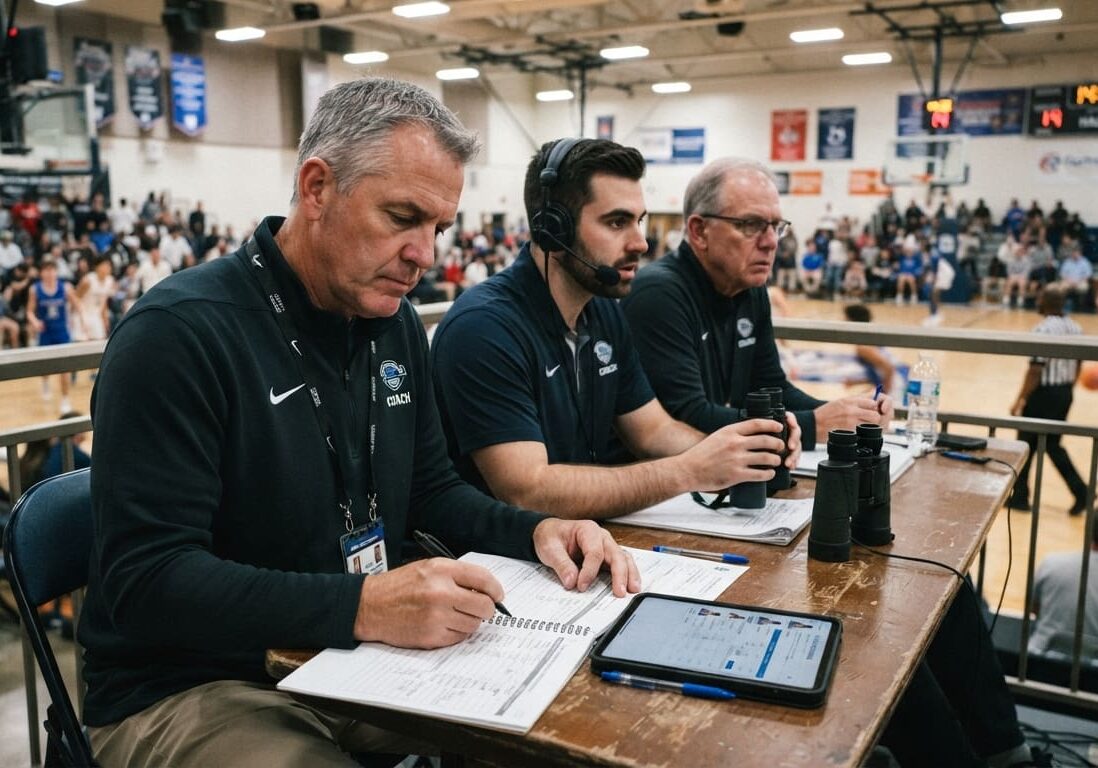
When college basketball coaches attend exposure tournaments, they look for players who possess a combination of high basketball IQ, elite physical and athletic tools, relentless defensive effort, and exceptional intangibles such as positive body language and coachability. While raw scoring ability catches the eye, recruiters from NCAA Division I, II, III, and NAIA programs evaluate how a prospect’s skills translate to the collegiate level. At high-profile exposure events, such as those hosted by Big Time Hoops, college scouts are not just watching the ball; they are scanning the entire court to evaluate a player’s off-ball movement, defensive rotations, communication, and overall physical profile during the NCAA live recruiting periods.
The Anatomy of a College Coach’s Evaluation Checklist
To stand out in a gym packed with hundreds of recruits, players must understand that college scouts do not watch games the way fans do. A fan follows the ball; a college coach follows the player. Coaches arrive at tournaments with a specific list of roster needs and positional profiles. They are looking for prospects who can seamlessly plug into their system and contribute to winning.The evaluation process can be broken down into four primary pillars:
- Physical Profile and Athleticism: Height, wingspan, lateral quickness, vertical leap, and functional strength.
- Basketball IQ and Skill Set: Decision-making, court vision, shooting mechanics, spatial awareness, and position-specific skills.
- Defensive Impact: On-ball containment, help-side positioning, communication, and willingness to contest shots and rebound.
- Intangibles and Character: Body language, interaction with teammates and coaches, response to adversity, and bench behavior.
Coaches often make up their minds about a player’s athletic viability within the first five minutes of warm-ups. However, verifying a player’s mental toughness, competitive drive, and tactical discipline requires observing them through the ups and downs of a full tournament game.
On-Court Performance Indicators: Technical & Tactical Metrics
1. Basketball IQ and Decision-Making
A high basketball IQ is one of the most sought-after traits at the collegiate level. College systems are highly tactical, requiring players to read and react to complex defensive coverages in real time. Scouts look for players who make the “simple play” rather than the “home run play.” This includes:
- Patience in the Pick-and-Roll: Can a guard read the hedge, drop, or switch and make the correct pass or scoring move?
- Shot Selection: Does the player force contested shots early in the shot clock, or do they work the offense to find high-percentage looks?
- Spatial Awareness: Understanding spacing on the floor, cutting when a defender overplays, and filling the correct lanes in transition.
2. Defensive Versatility and Effort
Many high school players focus entirely on offense, but college coaches know they cannot play a recruit who is a defensive liability. Scouts look for:
- Lateral Quickness and Footwork: Can the player stay in front of quick guards without fouling?
- Help-Side Rotations: Is the player in the correct position when the ball is on the opposite side of the floor, or are they asleep?
- Transition Defense: Does the player sprint back to protect the rim, or do they jog back while complaining to the referees?
3. Positionless Versatility
Modern college basketball highly values positionless players—guards who can rebound, forwards who can handle the ball, and big men who can stretch the floor and defend multiple positions. If you are a guard, coaches want to see if you can defend both guard spots. If you are a forward, they want to see if you can switch onto smaller guards on the perimeter or battle in the post.
The Intangibles: What Coaches Watch When You Think They Aren’t
The difference between a scholarship offer and a skipped recruit often lies in the intangibles. College coaches spend significant time watching players during dead-ball situations, timeouts, and warm-ups.
The Warm-Up Routine
A player’s warm-up routine tells a coach how seriously they take the game. Scouts look for focused, game-speed repetitions. Players who goof off, shoot half-court shots, or show lackadaisical effort during warm-ups are often crossed off the recruiting list immediately.
Response to Adversity and Body Language
Every player will make mistakes, miss shots, or get called for a bad foul. College coaches want to see how a player responds to these moments:
- Do they hang their head, pout, or slow-jog back on defense?
- Do they yell at their teammates or roll their eyes at their coach?
- Or do they immediately sprint back, encourage their teammates, and focus on the next play?
Bad body language is a major red flag. It signals to a coach that the player is selfish, fragile, or uncoachable.
Interaction with Referees, Coaches, and Parents
Scouts watch how players interact with authority figures. A player who constantly argues with officials, ignores their high school or AAU coach during timeouts, or yells at their parents in the stands is viewed as a recruiting risk. Coaches want players who are coachable and possess high emotional intelligence.
Physical and Athletic Baselines by NCAA Division Level
While exceptions exist, college programs generally look for specific physical and athletic baselines when recruiting high school prospects. The table below outlines the typical profiles coaches look for across different division levels.
| Division Level | Point Guards | Shooting Guards / Wings | Forwards / Centers | Key Athletic Traits |
|---|---|---|---|---|
| NCAA Division I | 6’0″ – 6’3″+ Elite speed, tight handle, paint touch ability. |
6’4″ – 6’7″+ Multidimensional scorers, elite wingspan, perimeter defenders. |
6’8″ – 7’0″+ Rim protectors, lob threats, or stretch-four capabilities. |
Elite lateral quickness, explosive vertical, high-level functional strength. |
| NCAA Division II | 5’10” – 6’1″ High IQ, great shooters, excellent playmakers. |
6’2″ – 6’5″ Consistent shooters, solid defenders, high-volume scorers. |
6’6″ – 6’9″ Rebounding specialists, physical post presence, pick-and-pop threats. |
Strong athleticism, solid lateral movement, high-level endurance. |
| NCAA Division III | 5’8″ – 6’0″ Exceptional leaders, high IQ, high assist-to-turnover ratio. |
6’0″ – 6’4″ High academic achievers, knockdown shooters, team defenders. |
6’4″ – 6’8″ Fundamentally sound, high-motor rebounders, screen setters. |
Good lateral movement, high work ethic, fundamental positioning. |
| NAIA | 5’10” – 6’2″ Dynamic playmakers, gritty defenders, high scoring ability. |
6’2″ – 6’6″ Athletic slashers, versatile defenders, transition threats. |
6’5″ – 6’9″ Physical inside-out players, high-motor rebounders. |
Highly competitive, physical toughness, explosive transition speed. |
How College Coaches Prepare for and Navigate Tournaments
College coaches do not show up to tournaments to “discover” players from scratch. The recruiting process is highly calculated. Before stepping foot in an exposure venue, coaching staffs spend weeks preparing.
The Pre-Tournament Sourcing Phase
Coaches build a target list of recruits based on recommendations from trusted high school coaches, AAU directors, recruiting services, and video databases. They look up the schedules of these specific players and map out which courts they need to be at during every hour of the tournament.
The Evaluation Phase
When a coach sits sideline, they are cross-referencing what they see live with their pre-existing scouting reports. They are checking to see if a player’s listed height is accurate, if their speed translates against elite competition, and how they handle physical play.
The “Sleeper” Discovery
While coaches have a plan, they always keep their eyes open for unexpected talent. If a player on the opposing team is outperforming their targeted recruit, coaches will quickly look up that player’s number in the tournament book, check their GPA, and add them to their watch list. This is why playing hard on every possession is critical—you never know who is watching the court next to yours or observing your matchup.
Common Recruiting Mistakes Players Make at Exposure Events
To maximize your chances of being recruited, avoid these common pitfalls that can instantly turn off college scouts:
- Hunting Shots: Forcing bad shots to boost your scoring average. Coaches value efficiency over volume. A player who scores 12 points on 5-of-8 shooting is far more attractive than a player who scores 20 points on 7-of-22 shooting.
- Over-Dribbling: Holding the ball and trying to break down defenders with excessive crossover moves. College offenses rely on quick ball movement. Over-dribbling kills team flow and signals a lack of understanding of team basketball.
- Playing Soft: Avoiding contact, failing to box out, or refusing to dive for loose balls. Coaches want competitors who are willing to do the dirty work to win games.
- Ignoring the Bench: Showing a lack of enthusiasm when subbed out, sitting away from the team, or failing to cheer for teammates. Your behavior on the bench tells coaches what kind of teammate you will be in their locker room.
Real-Time Search Queries & Recruiting Trends
Understanding what players and parents are actively searching for can help demystify the recruiting landscape. Here are the most common search queries regarding college basketball recruiting at tournaments:
- “How do college coaches find players at AAU tournaments?”
- “What do D1 basketball coaches look for in a point guard?”
- “How to get noticed at basketball exposure camps?”
- “Do college coaches look at GPA during tournaments?”
- “What is the NCAA basketball recruiting calendar?”
These queries highlight a common theme: players want to know how to bridge the gap between playing in a tournament and actually getting on a coach’s recruiting board. The answer lies in proactive communication, maintaining high academic standards, and playing with a high motor at certified exposure events.
Frequently Asked Questions
Do college coaches care about my attitude on the bench?
Yes, absolutely. College coaches pay close attention to how you behave when you are not playing. They look to see if you are cheering for your teammates, engaged in the huddles, and accepting of your coach’s decisions. A poor attitude on the bench is one of the fastest ways to lose a scholarship offer.
How important is my GPA to a college basketball coach?
Your GPA is incredibly important. Even if you are an elite athlete, coaches will not recruit you if you are academically ineligible or a risk to fail out of college. High academic standing shows discipline, responsibility, and makes the admissions process much easier for the coaching staff, especially at academic-heavy Division III and Ivy League schools.
Should I email college coaches before a tournament?
Yes. You should send a polite, concise email to college coaches 1-2 weeks before a tournament. Include your name, jersey number, team name, schedule, court numbers, and a link to your highlight video. This allows coaches to add you to their schedule before they arrive at the venue.
What is the difference between a live period and a non-live period?
During an NCAA “Live Period” (Evaluation Period), college coaches are permitted to watch prospects play in person at NCAA-certified events. During non-live periods (Quiet or Dead Periods), coaches cannot watch players in person, though they can still communicate via phone, email, or social media depending on the recruiting calendar rules for your class.
Can I get recruited if I am not on a major shoe-circuit team?
Yes. While shoe-circuit events (EYBL, 3SSB, UAA) get a lot of attention, college coaches from all levels attend independent exposure tournaments to find talent. What matters most is playing against quality competition, putting together high-quality film, and performing well when coaches are on the sidelines.