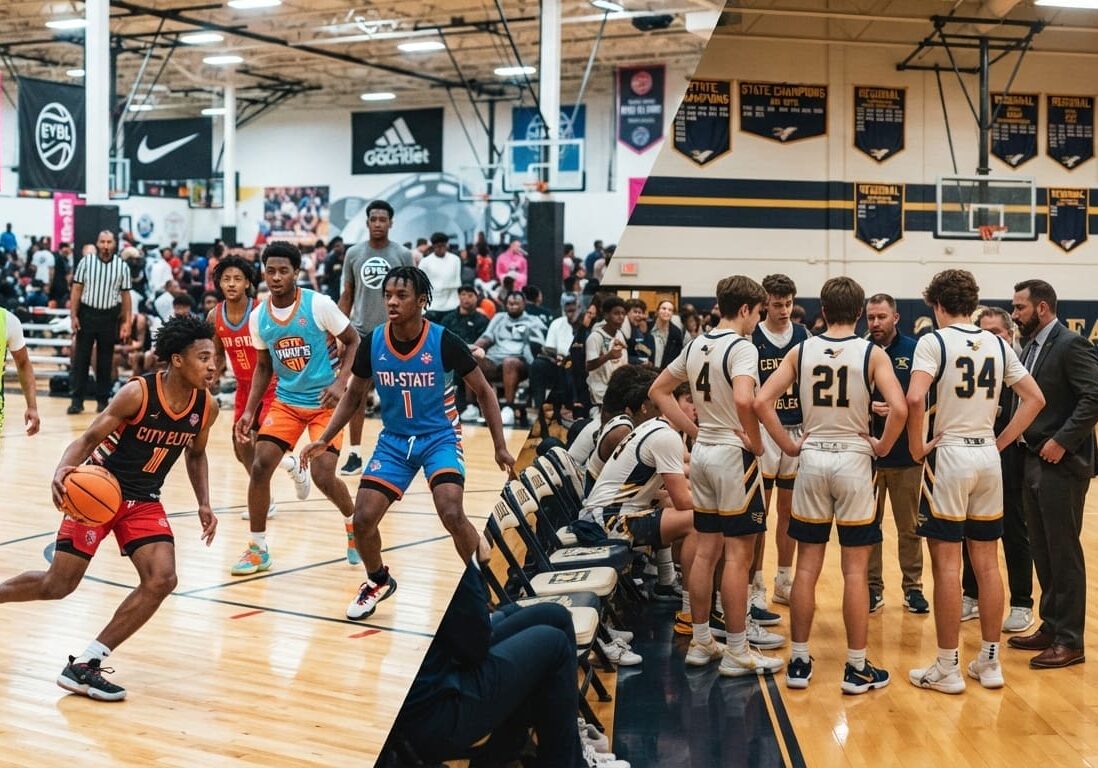
AAU vs School Basketball Tournaments: What’s the Difference?
When navigating the competitive youth basketball landscape, players, parents, and coaches often face a critical crossroads: AAU vs school basketball tournaments. While both pathways offer a stage for young athletes to showcase their skills, they serve fundamentally different purposes, operate under distinct governing bodies, and offer contrasting routes to college recruitment. Understanding these differences is crucial for any athlete aiming to maximize their development, gain maximum exposure, and make informed decisions about their athletic future.
The primary difference between AAU (Amateur Athletic Union) basketball and scholastic school basketball lies in their structural goals and recruiting environments. School basketball focuses on community pride, structured team play, defensive systems, and state championship pursuits under strict state high school athletic association rules. Conversely, AAU and club basketball tournaments focus heavily on individual player exposure, high-tempo offensive play, national travel, and direct competition in front of college scouts during designated NCAA evaluation periods. To navigate this landscape successfully, families often rely on trusted tournament organizers like Big Time Hoops, a premier platform hosting high-exposure youth basketball tournaments that bridge the gap between raw talent and collegiate scouting.
The Structural DNA: How AAU and School Basketball Differ
To fully grasp the dynamics of youth basketball, one must analyze the organizational structures that govern these two worlds. They operate on different calendars, utilize different rulebooks, and prioritize different aspects of the game.
1. Governing Bodies and Seasonality
School basketball is highly regulated. It is governed by the National Federation of State High School Associations (NFHS) at the national level and managed by individual state associations (such as the IHSA in Illinois or the TXUIL in Texas). The season is strictly defined, typically running from November through March. Players must attend the school they represent, creating a natural geographic and community-based bond.
AAU and independent club basketball, on the other hand, operate in a more decentralized environment. While the Amateur Athletic Union is a specific organization, the term “AAU” is widely used to describe the entire landscape of non-scholastic club basketball, including independent circuits and major shoe-sponsored leagues (such as the Nike EYBL, Adidas 3SSB, and Under Armour Association). The club season runs primarily from spring through summer (late March to October), filling the off-season of scholastic basketball.
2. Roster Construction and Geographic Boundaries
In school basketball, you play with the hand you are dealt. Roster construction is restricted by school enrollment boundaries, residency requirements, and transfer rules. This fosters deep chemistry, as teammates often grow up playing together in local middle schools and recreational leagues.
AAU teams have virtually no geographic boundaries. A single team can feature elite players from multiple cities, states, or even countries. Rosters are built through tryouts, invitations, and active recruitment by club directors. This allows for the concentration of elite talent on a single roster, creating “super teams” that compete on national circuits.
The Recruiting Paradigm: Where Do College Coaches Look?
For athletes aspiring to play at the collegiate level, understanding the recruiting dynamics of both platforms is essential. The recruiting calendars and scouting methods differ drastically between the winter school season and the spring/summer club circuit.
NCAA Live Periods: The AAU Advantage
The NCAA establishes specific times of the year known as Evaluation Periods or “Live Periods.” During these windows (typically in April, May, and July), Division I and Division II college coaches are permitted to scout prospective student-athletes in person.
Because hundreds of elite teams gather under one roof at major travel tournaments, college coaches can evaluate dozens of prospects in a single weekend. A college scout can sit on a baseline at a tournament hosted by organizations like Big Time Hoops and watch ten high-caliber games back-to-back, making it an incredibly cost-effective and time-efficient scouting method.
The Scholastic Recruiting Window
While college coaches do attend high school games, their ability to do so during the winter is limited by their own competitive seasons. College coaches are busy managing their own teams, practicing, and playing games from November to April. Consequently, high school scouting is often delegated to local assistants, recruiting services, or conducted via film review (platforms like Hudl and Synergy Sports).
However, high school basketball has adapted by introducing June scholastic live periods, where state coaching associations host team camps. This allows college coaches to evaluate prospects playing within their high school systems, offering a balanced view of how a player performs within a structured team concept.
Comparing the Game: Style of Play, Rules, and Player Development
The debate between AAU and school basketball often centers on the style of play and its impact on long-term player development. Critics and proponents exist on both sides, and each environment cultivates different skill sets.
| Feature/Metric | School Basketball Tournaments | AAU & Club Tournaments |
|---|---|---|
| NFHS / State Associations | AAU / Independent / Shoe Circuits | |
| Winter (November – March) | Spring & Summer (April – July/August) | |
| Structured, system-oriented, defensive-focused | Up-tempo, transition-heavy, isolation/spacing | |
| Local students, limited geographic pool | Regional or national talent, hand-selected | |
| Regional scouts, film-based, June live events | NCAA Spring/Summer Live Periods, national exposure | |
| Minimal (funded by schools/boosters) | Moderate to high (travel, registration, lodging) |
The High School Style: Discipline and Systems
School basketball coaches typically have more practice time with their athletes. They can install complex offensive systems (such as the motion offense, Princeton offense, or set plays) and detailed defensive schemes (such as pack-line, matchup zones, and full-court presses).
Games are characterized by high stakes, intense local rivalries, and crowded, passionate gymnasiums. Because every game counts toward conference standings and playoff seeding, there is a premium placed on possessions, shot selection, defensive rotations, and execution. This environment teaches players how to win, play under pressure, and accept specific roles within a team framework.
The AAU Style: Freedom, Pace, and Individual Showcase
AAU tournaments feature a fast-paced, high-possession style of play. Because teams have limited practice time together, coaches rely on simple offensive spacing, pick-and-roll actions, and transition offense. This style mimics the modern NBA and collegiate trends, prioritizing spacing, isolation play, and individual decision-making in the open court.
While critics argue that AAU can sometimes foster selfish play or lack defensive intensity, proponents point out that it forces players to develop elite 1-on-1 skills, shot-creation abilities, and transition decision-making. Facing elite, athletic defenders every weekend forces players to adapt far quicker than they would playing against average local high school competition.
Analyzing the Financial and Logistical Commitments
The choice between focusing on high school play or diving deep into the travel basketball circuit carries significant financial and logistical implications for families.
The Cost of High School Basketball
High school basketball is highly accessible. Most costs are covered by the school district’s athletic budget, booster clubs, or modest participation fees. Uniforms, travel to away games, and coaching are provided. Logistically, practices and games take place immediately after school, minimizing the travel burden on parents.
The Investment in AAU Travel Basketball
AAU basketball can be a significant financial investment. Club fees can range from a few hundred to several thousand dollars per season. This covers tournament entry fees, gym rentals, coaching stipends, and uniforms.
Additionally, families must factor in travel expenses, including flights, hotels, gas, and meals for weekend tournaments. While elite, shoe-sponsored teams (like Nike EYBL) are often fully funded, the vast majority of players operate on “pay-to-play” club teams.
“AAU basketball is an investment in exposure and development. While high school basketball builds character and community, AAU puts you on the national radar. Balancing both is the key to a complete recruiting profile.”
— National Recruiting Analyst
Real-Time Search Queries: What Players and Parents Want to Know
To help demystify this decision-making process, let’s address the top search queries that players, parents, and coaches frequently search for online.
Is AAU better than high school basketball?
Neither is objectively “better” because they serve different developmental needs. High school basketball is superior for learning discipline, executing defensive systems, playing under pressure, and building team chemistry. AAU is superior for individual skill exposure, playing against elite athletic competition, and getting evaluated by college coaches from across the nation during NCAA live periods.
Do college scouts watch high school games?
Yes, college scouts watch high school games, but their focus is highly targeted. They typically visit high schools to watch specific prospects they have already identified through the AAU circuit or recruiting databases. They also use high school games to evaluate a player’s character, body language, how they interact with coaches, and how they perform within a disciplined system.
Can you get recruited to play college basketball just by playing high school?
While possible, it is increasingly difficult, especially for Division I and Division II levels. Unless you play for a nationally ranked prep school or a high school powerhouse that participates in major holiday tournaments, relying solely on the high school season limits your exposure. Participating in reputable travel circuits is highly recommended to maximize recruiting opportunities.
The Hybrid Path: How to Balance Both for Maximum Success
The most successful athletes do not choose one over the other; they leverage both systems to build a comprehensive athletic profile. Here is a strategic roadmap on how to balance both pathways throughout your high school career:
- Fall (September – October): Focus on individual skill development, strength and conditioning, and attending elite exposure camps.
- Winter (November – March): Commit fully to your high school team. Focus on winning, executing your coach’s system, being a great teammate, and building game film.
- Spring (April – May): Transition to the AAU circuit. Play in high-quality independent tournaments, such as those hosted by Big Time Hoops, to shake off the rust and get seen during the early NCAA live periods.
- June (Scholastic Live Period): Return to your high school team for team camps and state-sponsored live events where college coaches evaluate high school chemistry.
- July (The Peak AAU Season): Play in national championship tournaments and shoe-circuit finales. This is the prime window for earning scholarship offers.
Frequently Asked Questions
What does AAU stand for in youth sports?
AAU stands for the Amateur Athletic Union. Founded in 1888, it is one of the largest non-profit volunteer sports organizations in the United States. Today, the term “AAU” is colloquially used to describe all competitive travel, club, and non-scholastic basketball programs, regardless of whether they are officially affiliated with the AAU organization.
Are AAU coaches certified?
Unlike high school coaches, who must be certified educators or pass rigorous state athletic association certification courses (including background checks, CPR, and first aid training), AAU coaching requirements vary. Elite circuits require background checks through USA Basketball, but independent local club coaches may not face the same level of scrutiny. It is important for parents to research a club’s coaching staff before committing.
How many games do you play in an AAU tournament vs. a high school season?
A typical high school season consists of 20 to 30 games played over a five-month span, averaging 1 to 2 games per week. An AAU weekend tournament can feature 3 to 6 games compressed into a 48-hour window. Over a full spring and summer circuit, an AAU player might play 40 to 60 games.
What is a “shoe-sponsored” AAU team?
Shoe-sponsored teams are elite club programs sponsored by major athletic brands like Nike (EYBL), Adidas (3SSB), or Under Armour (UAA). These brands fund the teams, providing free gear, shoes, and travel sponsorships. These leagues feature the top 1% of high school prospects in the country and draw the highest concentration of Division I college coaches.
Making the Right Choice for Your Basketball Journey
Ultimately, the debate between AAU and school basketball tournaments is not about choosing a winner—it is about understanding how to use both platforms to achieve your personal goals. School basketball provides the foundation of discipline, team play, and community pride that shapes character. AAU tournaments provide the platform for exposure, elite competition, and national recruiting that can open doors to higher education.
By understanding the unique advantages of each, managing the physical demands of a year-round schedule, and partner-marketing your talents through trusted platforms like Big Time Hoops, you can navigate the modern youth basketball landscape with confidence and position yourself for long-term success both on and off the court.