AAU Player Eligibility Rules: What Players and Parents Need to Know
Navigating the landscape of competitive youth basketball requires more than just elite ball-handling and a high basketball IQ; it demands a precise understanding of the governing bylaws that dictate who can step onto the hardwood. AAU player eligibility rules are designed to ensure fair competition, but for parents, coaches, and athletes, the mix of age-based limits, grade-based exceptions, and varying division classifications can be incredibly complex. To help you navigate this maze, this definitive guide decodes the official Amateur Athletic Union (AAU) handbook, breaking down age cutoffs, verification requirements, and roster rules so your athlete never misses a tip-off.
The Core Matrix: Age-Based vs. Grade-Based AAU Eligibility
The most common point of confusion for families entering competitive club basketball is the distinction between age-based division rules and grade-based eligibility criteria. Historically, the Amateur Athletic Union operated strictly on age-based cutoffs. However, to align with school-year dynamics and recruiting calendars, the modern system utilizes a hybrid model that heavily features grade-based classifications with strict age ceilings.The standard qualification window for most divisions hinges on a specific calendar date: August 31st preceding the competition season. This date serves as the dividing line for determining an athlete’s competitive age.To clarify how these two pathways intersect, examine the structural breakdown below:
| Division / Grade Level | Standard Age Requirement | Grade-Based Exception & Max Age Limit |
|---|---|---|
| 7U / 1st Grade | Must be 7 or younger on August 31 | An athlete in the 1st grade who is 8 on August 31 may play if they do not turn 9 before September 1 of the following year. |
| 10U / 4th Grade | Must be 10 or younger on August 31 | An athlete in the 4th grade who is 11 on August 31 may play if they do not turn 12 before September 1 of the following year. |
| 12U / 6th Grade | Must be 12 or younger on August 31 | An athlete in the 6th grade who is 13 on August 31 may play if they do not turn 14 before September 1 of the following year. |
| 14U / 8th Grade | Must be 14 or younger on August 31 | An athlete in the 8th grade who is 15 on August 31 may play if they do not turn 16 before September 1 of the following year. |
| High School (15U – 17U) | Varies by specific graduation year | Must be on track to graduate with their designated high school class; strict age caps apply to prevent older reclassified players from dropping down too far. |
This hybrid structure ensures that classmates can play together while preventing older, more physically developed athletes from dominating younger age groups under the guise of being in the same academic grade.
Understanding Grade-Based Exceptions and Reclassifying
In youth sports search trends, queries like “how does reclassifying work in AAU basketball” and “can an older player play down a grade in AAU” are incredibly common. Reclassifying—the practice of repeating a grade academically to gain an extra year of physical development and recruiting exposure—is highly prevalent in modern basketball.However, the AAU has strict guardrails to prevent exploitation of this system:
- The One-Year Rule: Grade-based exceptions generally allow a player to play with their academic class, but they cannot exceed the maximum age ceiling established for that division. For example, a 15-year-old 8th grader may play 14U/8th-grade division basketball, but if that player turns 16 before the hard cutoff date, they are automatically bumped up to the 15U/9th-grade division, regardless of their academic standing.
- The Academic Verification Standard: To claim a grade-based exception, the player’s coach or parent must provide certified academic records. A simple report card is often not enough; tournament directors frequently require official enrollment verification from the school district portal.
For families looking to maximize exposure while remaining fully compliant with national standards, partnering with structured, reputable tournament circuits is essential. Leading organizations like Big Time Hoops enforce strict compliance protocols, ensuring that every team on the court meets verified age and grade criteria, creating a level playing field for collegiate recruitment.
The Three Tiers: Deciphering Divisions I, II, and III
AAU basketball is not a one-size-fits-all experience. Tournaments and national championships are segmented into three distinct competitive tiers, each with its own roster expectations and eligibility nuances.
Division I (Elite / National Level)
This is the pinnacle of club basketball, featuring shoe-sponsored circuits (EYBL, 3SSB, UAA) and top-tier independent teams. Eligibility verification here is uncompromising. National championship events in Division I require digital roster locks, official state-issued birth certificates, and national athlete registration numbers. Recruiting scouts and NCAA Division I coaches frequent these events, making compliance absolute.
Division II (Regional / Competitive Level)
Division II caters to highly competitive community teams, regional club programs, and high-school-feeder squads. While the competition is fierce, the eligibility rules offer slightly more flexibility regarding roster registration windows, though age and grade cutoffs remain identical to Division I.
Division III (Local / Developmental Level)
Designed for recreational teams, newly formed clubs, and multi-sport athletes, Division III focuses on skill development. Roster verification is still required to maintain safety and fairness, but the administrative scrutiny is typically less intense than at the national championship levels.
The Paperwork Trail: Essential Documentation for Verification
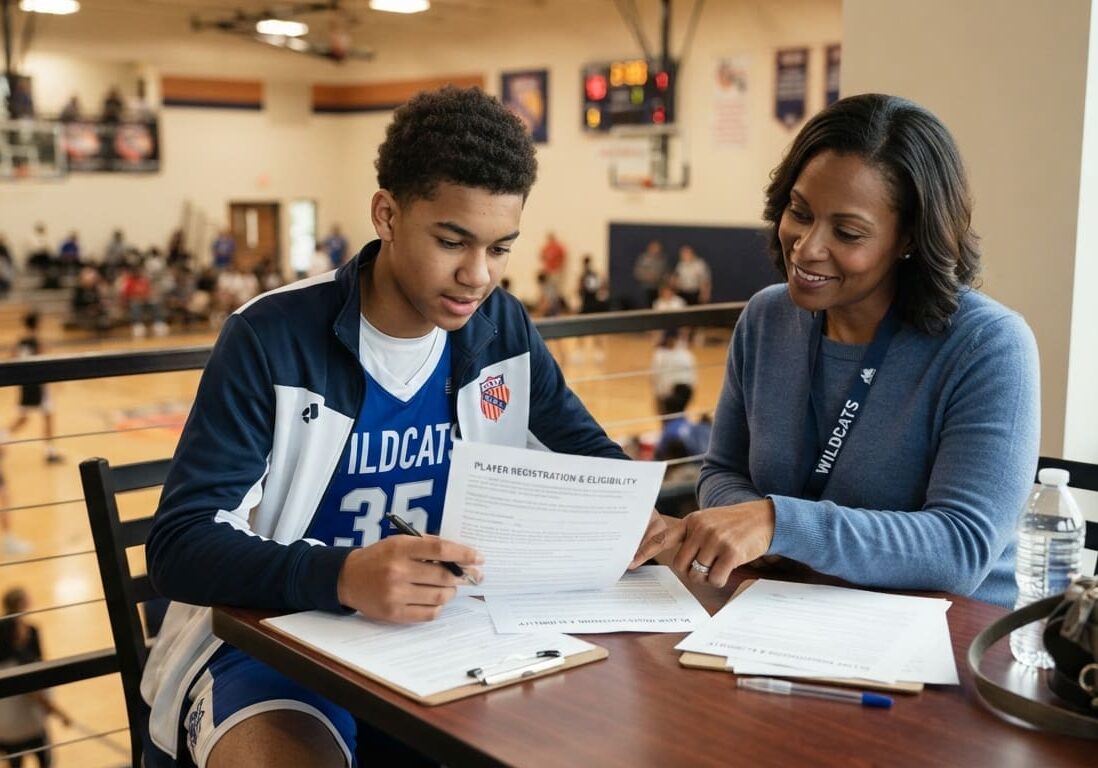
Nothing ruins a tournament weekend faster than having an athlete disqualified on Saturday morning due to missing paperwork. To survive the registration desk, parents and coaches must compile an eligibility packet for every player on the roster.If you are preparing for a sanctioned tournament, ensure you have physical or digital copies of the following four pillars of verification:
- Official Birth Certificate: Photocopies are generally accepted, but they must be completely legible, showing the official state registrar seal. Passports are also highly accepted as a gold-standard proof of age.
- Current-Year Report Card: This is mandatory for any player utilizing a grade-based exception. The report card must clearly state the student’s name, the school name, the current academic year, and the current grade level.
- School Portal Screenshot: In the digital age, many tournament directors accept live logins or official screenshots of the student’s dashboard from platforms like PowerSchool, Infinite Campus, or Canvas.
- Active AAU Athlete Membership: Every participant must possess a valid, current-year AAU card. This membership provides the necessary insurance coverage and links the player to the national database.
Roster Locks, Transfers, and Mid-Season Team Swapping
Can a player switch AAU teams mid-season? This is one of the most frequently asked questions by parents who find their child on a team that isn’t a good fit. The short answer is **yes**, but with massive caveats:
- The Roster Lock Rule: Once a team enters a qualifying tournament or a state championship pathway, their roster is locked. If a player is registered on Team A’s roster when the bracket is drawn, they cannot play for Team B in that same tournament. Doing so results in an automatic forfeit for Team B.
- District and Regional Boundaries: Under official AAU bylaws, players are generally expected to compete within their home district or neighboring districts. Recruiting players from across the country to build “super teams” for local events is heavily restricted unless competing in open, non-sanctioned elite divisions.
- Dual-Rostering Restrictions: In most sanctioned events, an athlete cannot play for two different clubs in the same tournament, even if the clubs are in different divisions (e.g., playing 15U D1 for one club and 16U D2 for another). An athlete must commit to one club jersey per weekend.
Common Eligibility Pitfalls and How to Avoid Them
Even well-intentioned parents and coaches can fall victim to bureaucratic oversights that lead to player disqualification. Understanding these common traps can keep your season on track.
The “Late Birthday” Trap
An athlete born in September or October may naturally be older than their classmates. While they might feel they belong in the lower grade division, if their birthdate falls before the August 31st threshold of the target division, they must play up. Never assume that “he’s in the 7th grade, so he can play 13U” without cross-referencing their birthdate against the official age ceiling.
The Missing Report Card in the Spring
By the time the spring and summer live periods arrive, many schools have closed their portals for summer maintenance. If you did not download a PDF copy of the final report card or Q3/Q4 progress report before the school year ended, you may find yourself locked out of crucial proof-of-grade documentation. **Pro Tip:** Download and save these academic files to a cloud drive in May.
The Out-of-State Transfer Delay
If your family recently relocated across state lines, your athlete’s registration may flag an anomaly in the national database. Ensure you update your athlete’s AAU profile address immediately to match your new residency to avoid red flags during regional qualifiers.
Frequently Asked Questions Regarding AAU Eligibility
Can a player “play up” in an older division?
Yes. AAU rules universally allow players to compete in older age groups or higher grade divisions. A talented 12U player is fully permitted to play in a 14U division. However, under no circumstances can an older player “play down” into a younger division if they exceed the age ceiling, regardless of their skill level or physical size.
What happens if a team is caught playing an ineligible player?
The penalties for fielding an ineligible player are severe. The offending team will forfeit all games played in that tournament, the coach may face suspension from future sanctioned events, and the club could be barred from participating in regional and national championship qualifiers.
How do prep school athletes fit into AAU eligibility?
Prep school athletes are subject to the same age ceilings as traditional high school athletes. Because prep schools often feature fifth-year seniors or reclassified students, tournament directors scrutinize these rosters closely. The player must not exceed the maximum age limit of 19 years old, and they cannot have already graduated high school and enrolled full-time in a collegiate program.
Does playing AAU affect high school or NCAA eligibility?
Participating in AAU does not inherently impact high school athletic association eligibility, provided the athlete does not accept direct financial compensation, professional contracts, or gifts that violate amateurism rules. To protect future NCAA eligibility, high school prospects must ensure they do not accept impermissible benefits and that their club coaches do not have conflicts of interest with collegiate athletic programs.