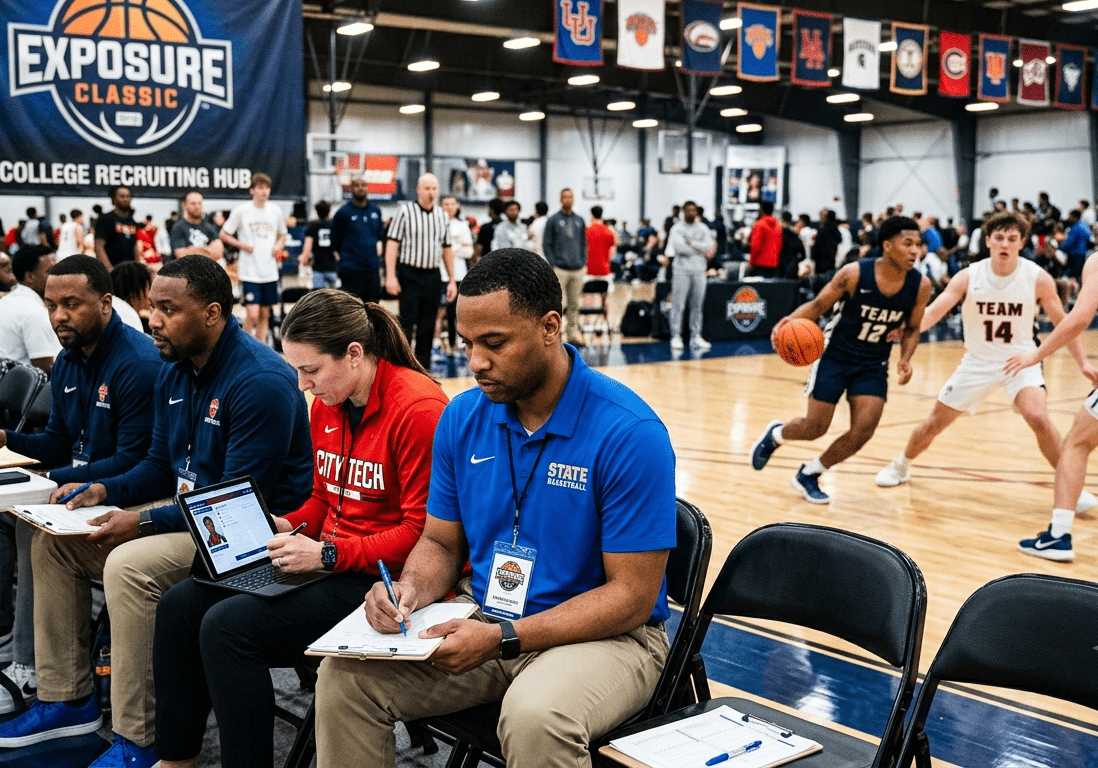
How College Basketball Coaches Evaluate Players at Exposure Tournaments
How College Basketball Coaches Evaluate Players at Exposure Tournaments
Exposure tournaments are one of the most important stages in the college basketball recruiting ecosystem. For high school athletes, these events can directly influence scholarship offers, roster spots, and long-term playing opportunities. For college coaches, they are high-intensity evaluation environments where decisions must be made quickly, accurately, and strategically.
This article breaks down exactly how college basketball coaches evaluate players at exposure tournaments, what they look for beyond box scores, and how athletes can maximize their visibility in front of recruiters.
What Are Exposure Tournaments in Basketball?
Exposure tournaments are organized basketball events designed to showcase high school players in front of college coaches, scouts, and recruiters. These events typically feature elite club teams, often from circuits like the Amateur Athletic Union or major shoe circuits such as the Nike Elite Youth Basketball League.
Unlike regular high school games, exposure tournaments are heavily attended by college coaching staffs who are actively recruiting talent across multiple classes (freshmen through seniors).
Common exposure events include:
- Live recruiting periods sanctioned by the NCAA
- AAU circuit tournaments
- Invitational showcases
- Regional and national camps
- Shoe-brand sponsored circuits (Nike, Adidas, Under Armour)
These events compress a massive amount of talent into one place, allowing coaches to evaluate dozens of players in a single weekend.
Common Types of Exposure Events
| Event Type | Description |
| AAU Circuit Events | Club-based tournaments featuring elite youth teams |
| Shoe Circuit Events | Nike, Adidas, Under Armour sponsored competitions |
| NCAA Live Period Events | NCAA-sanctioned recruiting weekends |
| Showcases & Camps | Skill + game-based evaluation settings |
| National Invitationals | High-profile multi-team recruiting tournaments |
These events compress hundreds of evaluations into a short time window, allowing coaches to compare prospects directly under similar conditions.
Why Exposure Tournaments Matter for Recruiting
Exposure tournaments matter because they solve three major recruiting problems: access, comparison, and efficiency.
Key Benefits for Coaches
| Benefit | Why It Matters |
| Direct Comparison | Players compete in the same environment |
| High Talent Density | Elite prospects in one location |
| Time Efficiency | Evaluate multiple recruits in one weekend |
| Pressure Testing | Reveals real competitive habits |
| System Translation | Shows how players function in structure |
Instead of traveling to individual high schools, coaches can evaluate dozens of prospects within hours.
How College Coaches Actually Evaluate Players
Contrary to popular belief, coaches are not tracking only points or highlight plays. Evaluation is structured, layered, and system-based.
Before games even begin, most coaching staffs already have:
- Player rankings and recruiting lists
- Game film and scouting reports
- Academic eligibility information
- Previous coach evaluations
- Statistical profiles
During games, evaluation shifts to live behavioral tracking.
Core Evaluation Categories Used by Coaches
Coaches typically evaluate players through four major lenses:
| Category | What Coaches Look For | Recruiting Impact |
| Physical Tools | Size, athleticism, length, mobility | Determines projection ceiling |
| Skill Execution | Shooting, passing, ball-handling, finishing | Measures current ability |
| Basketball IQ | Decision-making, spacing, reads | Determines system fit |
| Competitiveness | Motor, effort, response to pressure | Builds trust |
Each category interacts with the others. A weakness in one area can lower a player’s overall projection, even if others are strong.
What Coaches Track Beyond the Box Score
Box scores are often misleading in exposure settings. Coaches focus on possession-level value rather than raw numbers.
Key Hidden Evaluation Metrics
| Area | What Is Actually Evaluated |
| Shot Quality | Was the shot within the offense or forced? |
| Turnovers | Was it decision-based or pressure-induced? |
| Defensive Impact | Did the player disrupt actions even without stats? |
| Role Discipline | Did the player stay within system structure? |
| Energy Consistency | Effort across all possessions |
A player can score 20 points and still lose value if those points come from low-quality possessions.
Basketball IQ: The Most Important Separator
Basketball IQ is not just knowledge—it is processing speed under pressure.
Coaches evaluate:
- How fast a player reads defenses
- Whether decisions are made before pressure arrives
- Recognition of help defenders
- Transition decision-making
- Ability to simplify complex situations
Key Insight:
The best players are not those who make the most difficult plays—but those who consistently make the correct simple play quickly.
Defensive Evaluation: Where Trust Is Built
Defense is one of the strongest predictors of college readiness.
What Coaches Look For Defensively
- On-ball containment without fouling
- Help-side positioning discipline
- Communication and awareness
- Screen navigation
- Consistent effort regardless of possession involvement
Defense is especially important because it is harder to fake than offense. It reveals effort, discipline, and game awareness in real time.
Physical Tools and Projection
Athletic profile remains a major recruiting filter.
| Physical Trait | Evaluation Focus |
| Height/Length | Positional advantage |
| Speed | Transition impact |
| Lateral Quickness | Defensive versatility |
| Strength | Physical readiness |
| Vertical Ability | Finishing/rebounding potential |
However, projection matters more than current production. Coaches often prioritize long-term physical upside over present polish.
Efficiency vs Volume Scoring
Efficiency is one of the most important recruiting indicators.
Efficiency Indicators
- Shot selection quality
- Turnover rate relative to usage
- Early vs late-clock decision-making
- Ability to score within system flow
A player who scores less but operates efficiently is often graded higher than a high-volume scorer with poor shot selection.
Off-Ball Value: The Hidden Advantage
Many evaluations are made when a player does NOT have the ball.
Off-Ball Evaluation Areas
- Spacing discipline
- Timing of cuts
- Readiness to shoot
- Movement without disrupting flow
- Defensive positioning awareness
Players who excel off the ball are often seen as more “system-ready.”
Pressure and Emotional Control
Exposure tournaments are designed to test behavior under stress.
Coaches observe:
- Response after mistakes
- Body language consistency
- Communication under pressure
- Composure in tight games
Emotional instability often negatively affects recruiting evaluation more than skill mistakes.
Role Fit and System Understanding
College programs are structured systems, not individual showcases.
Role-Based Evaluation
| Role Type | What Coaches Expect |
| Primary Guard | Decision-making + control |
| Wing | Two-way versatility |
| Big Man | Rim protection + finishing |
| Combo Player | Adaptability + efficiency |
Players who accept roles tend to rise in evaluation because they reduce system uncertainty.
Turnovers and Possession Value
Turnovers are heavily scrutinized but interpreted contextually.
| Turnover Type | Evaluation Impact |
| Forced under pressure | Neutral/understandable |
| Careless decision | Negative |
| Lack of awareness | Highly negative |
Protecting possessions while remaining productive is a major recruiting advantage.
Consistency Across Games
Exposure tournaments allow multiple-game evaluation, which reveals consistency patterns.
Coaches value players who:
- Maintain performance across multiple games
- Avoid extreme highs and lows
- Show stable effort levels
- Repeat good habits consistently
Consistency reduces scouting risk.
Coachability: The Final Filter
When talent levels are similar, coachability becomes the deciding factor.
Coaches evaluate:
- Response to in-game feedback
- Willingness to adjust quickly
- Communication with teammates
- Openness to role changes
Coachable players are seen as lower-risk recruits with higher development upside.
Common Mistakes Players Make
| Mistake | Why It Hurts Evaluation |
| Forcing offense | Breaks system flow |
| Ignoring defense | Lowers trust instantly |
| Over-dribbling | Reduces efficiency |
| Poor body language | Signals low maturity |
| Inconsistent effort | Suggests unreliability |
How Offers Are Actually Made
Scholarship offers are rarely based on a single game.
Typical Decision Process
- Live evaluation at tournament
- Staff discussion and comparison
- Film review of multiple games
- Cross-check with recruiting board
- Academic eligibility review
- Final scholarship decision
One strong weekend can elevate a player onto a recruiting board, but sustained evaluation determines offers.
Final Takeaway
College basketball coaches evaluate players at exposure tournaments through a structured system focused on translation, not statistics. They prioritize decision-making, defensive reliability, efficiency, physical projection, and consistency over highlight production.
At elite levels like the Amateur Athletic Union (Amateur Athletic Union) and Nike Elite Youth Basketball League (Nike EYBL AAU circuit), every player is talented. The difference lies in who reduces uncertainty for coaches by consistently making winning basketball decisions under pressure.
Exposure tournaments do not just identify skilled players—they identify players who can be trusted at the next level.